
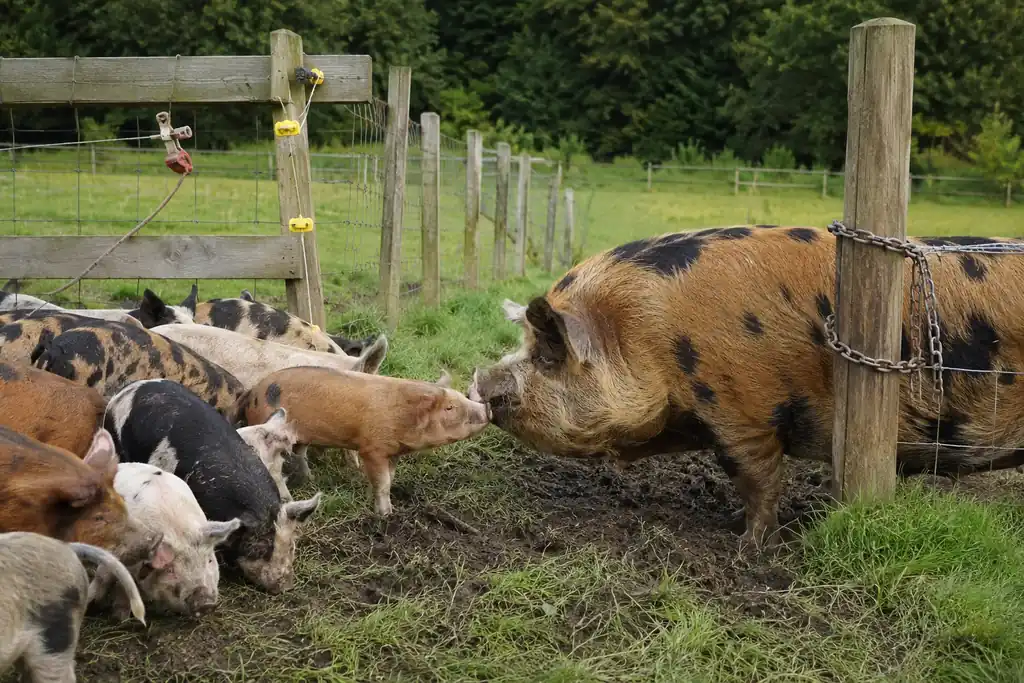
Sometimes pigs make it very clear that our plans are not the same as their plans.
When one of our momma pigs had her litter, I did what many pig owners would do. I separated her and the piglets from the rest of the herd with a board, thinking it would give the babies a little extra protection and give Momma some space to care for them without the other pigs crowding around.
The piglets were born with the other pigs nearby, so the herd already knew something was going on. Nobody seemed bothered. Nobody was acting aggressive. The other pigs were simply around, doing normal pig things.
Still, because newborn piglets are tiny, quick, and easy to worry over, I wanted a little separation.
That worked for a short time.
Then the piglets started finding the fence holes.
At only nine days old, those babies were already slipping through openings and wandering into the area with the rest of the pigs. They were not scared. They were not acting lost. They were just curious little piglets exploring the world like they owned the place.
The surprising part was how calm the rest of the herd stayed.
The other pigs ranged in age. There were two around six months old, one ten-month-old, and an older female from a previous litter who may be pregnant herself. There were no boars in the group, which made the situation a little easier to evaluate. None of the other pigs seemed interested in hurting the piglets. They mostly ignored them or accepted them as part of the normal herd activity.
Momma watched all this happening.
Eventually, she decided she was done with the arrangement. The piglets were going through the fence anyway, the other pigs were not bothering them, and the larger pen had more shade. So Momma pushed the barricade down and put herself right back in the big fence with her babies and the rest of the herd.
In other words, she solved the problem her own way.
Is It Common for Piglets to Be Raised Around Other Pigs?
Yes, it can be very common, especially in calm, well-managed Kunekune herds.
Many people separate a sow and her newborn piglets for the first couple of weeks. That early separation makes it easier to watch the litter, make sure everyone is nursing, check for weak piglets, and give Momma a peaceful place to settle into motherhood.
After the first week or two, though, plenty of piglets begin mixing with the larger herd without much trouble, especially if the herd is already familiar with the sow and there are no aggressive pigs or boars present.
In my current BF Farm routine, I keep a sow and her newborn litter in an individual area for roughly the first two weeks, until the piglets are tagged and microchipped. After that, I evaluate the next step based on the individual litter and setup.
At that point, piglets often act like all the mothers belong to them.
They may try to nurse from their own mother most of the time, but some piglets will test other sows too. In a calm group, the mothers may not care much. Some sows will even allow piglets from another litter to nurse. It depends on the sow, the herd, the setup, and how much milk demand is already on her.
Why Piglets Keep Escaping

Piglets are built low to the ground, full of curiosity, and surprisingly good at finding every weak spot in a fence.
A fence that easily holds adult Kunekunes may not hold piglets at all. To a nine-day-old piglet, a small gap can look like a doorway. They will squeeze through holes, crawl under loose boards, slip between panels, and test corners you did not even think were openings.
This is not always a sign that anything is wrong. Often, it simply means the piglets are healthy, curious, and beginning to explore.
That said, piglet escapes still matter.
The danger is not usually that the piglets want to explore. The danger is where they might end up. Piglets can get stuck, stepped on, chilled, overheated, separated too long from Momma, or trapped somewhere they cannot get back out.
Why Momma Wanted Back with the Herd
A sow knows where her piglets are. She may tolerate separation for a while, but if her babies are repeatedly crossing into another area, she may decide she needs access to them there too.
That appears to be exactly what happened.
Momma saw the piglets going into the larger pen. The larger pen had more shade. The other pigs were not bothering them. From her point of view, the barrier was no longer helping. It was keeping her from freely managing her litter.
So she pushed it down.
This is one of those moments where pig behavior makes perfect sense once we stop looking at it only from the human side. We saw a barricade. She saw an obstacle between herself and her babies.
The Role of Shade and Space

Shade matters a great deal, especially with pigs.
Pigs do not cool themselves effectively by sweating, so warm-weather comfort depends heavily on shade, abundant fresh water, airflow, and opportunities to cool their skin. Outdoor pigs may also use wet ground or a wallow to lose heat. A sow nursing piglets is already carrying a high nutritional workload, so keeping her comfortable and able to eat and drink without crowding matters. [1]
If the larger pen has better shade, better airflow, more room, and familiar herd members, it may actually be the better place for Momma and her piglets, provided it is safe.
This is why there is not always one perfect answer.
A smaller farrowing area may be safer for monitoring, but a larger shaded pen may be better for comfort. The best setup depends on the weather, fencing, herd temperament, piglet age, and how well Momma is handling things.
Why No Boars Makes a Difference
Having no boars in the group is important.
Boars are not automatically dangerous, but they add another layer of risk around young piglets. Size, breeding behavior, feed competition, and herd dynamics can all become more complicated when a boar is present.
In this situation, the group consisted of younger pigs and females, with no boars. That makes the setup more reasonable, especially since the other pigs were calm and uninterested in the piglets.
Still, even without boars, observation is important. Young pigs can be clumsy. Larger pigs may accidentally step on piglets, especially around feed, water, gates, shelters, or tight spaces.
When Herd-Raising Piglets Can Work Well
Letting piglets grow up around the herd can work well when several things are true:
- The sow is calm and attentive.
- The other pigs are not aggressive.
- There is enough room for everyone to move away from each other.
- There are no tight corners where piglets can get trapped.
- There is plenty of shade and shelter.
- Feed areas are not chaotic.
- Water is easy for Momma to access.
- Piglets can get back to their mother easily.
- There are no boars or rough adult pigs causing trouble.
- The fence is safe enough to keep piglets out of dangerous areas.
When those pieces are in place, piglets often do just fine in a family-style herd setting. They learn the herd routine early. They become confident. They follow Momma, explore, nap, nurse, and slowly begin acting like little members of the group.
When Separation Is Still the Better Choice
Even though herd-raising can work, separation is still better in some cases.
Separate the sow and piglets if another pig is biting, chasing, nosing too roughly, or guarding feed aggressively. Separate them if the piglets are being stepped on repeatedly, if the sow seems stressed, or if the piglets are not nursing well.
Separation may also be wise during extreme weather, especially if piglets need extra warmth, dryness, or protection from mud.
A first-time sow may need more privacy than an experienced mother. A nervous sow may not settle well with other pigs nearby. A very crowded pen is also not a good place for tiny piglets.
The goal is not to force one method. The goal is to read the pigs and choose the safest setup.
Watch the Piglets Closely
If piglets are staying in the larger herd, the most important job is observation.
Watch their bellies. Piglets that are nursing well usually have a filled-out look after feeding. Thin, tucked-up, weak, or constantly crying piglets need attention.
Watch how they move. Healthy piglets should be active, alert, and able to keep up with Momma.
Watch where they sleep. They need a dry, safe resting area where they are not being trampled or chilled.
Watch how the other pigs behave near them. Ignoring piglets is usually fine. Calm sniffing is usually fine. Chasing, biting, pinning, or rough shoving is not.
Watch the fence. If piglets can leave the safe pen and get into an unsafe area, the fence needs attention immediately.
Piglet-Proofing the Fence

Adult pig fencing is not always piglet fencing.
If piglets are slipping through holes, you may need to add smaller wire, boards, hog panels, or temporary barriers along the lower section of the fence. The goal is not always to keep them away from the herd forever. Sometimes the goal is simply to keep them from getting into places where they could be hurt.
Pay close attention to:
- Gaps under gates
- Corners where panels do not meet tightly
- Low spots under fencing
- Large square openings
- Loose boards
- Spaces behind shelters
- Areas near water tubs
- Any place a piglet could get in but not easily get back out
Piglets are tiny problem-solvers. If there is a gap, they will probably find it.
Feed Time Needs Extra Care

Feed time is one of the riskiest moments for piglets in a mixed group.
Even calm pigs can become pushy when feed appears. Piglets may get underfoot because they are curious, hungry, or simply following Momma. A larger pig does not have to be mean to hurt a piglet. Sometimes they are just big.
If Momma and piglets are with the herd, it helps to spread feed out or feed in a way that reduces crowding. Make sure Momma can eat enough without having to fight for every bite. Nursing takes a lot out of a sow, and she needs steady nutrition.
As piglets grow, they will start nibbling feed too. A creep area or piglet-safe spot where babies can access feed without being pushed around can be helpful.
Nursing Other Piglets
One interesting thing about group settings is that piglets may try to nurse from more than one sow.
Some mothers will not allow it. Others do not seem to care much. In some herds, piglets move between mothers and nurse wherever they can. They may still prefer their own mother, but they are opportunistic little creatures.
This can be completely normal in a calm group.
The important part is making sure every piglet is thriving and the nursing sows are not being drained too heavily. If one sow is feeding too many piglets or losing body condition, management may need to change.
What This Story Teaches
This little fence drama is a good reminder that pigs are social, intelligent, and very aware of their surroundings.
Momma knew where her babies were going. She knew the other pigs were not causing trouble. She knew the big pen had more shade. She decided the barricade was no longer useful.
From a human perspective, it looked like she broke the rules.
From a pig perspective, she fixed the setup.
That does not mean every sow should always be turned out with every herd immediately after farrowing. It does mean that we should pay attention when a calm, capable mother shows us what she wants and when the herd proves they can handle the piglets peacefully.
Final Thoughts
Raising piglets with other pigs can work very well in the right situation. It is especially common in calm herds where the sow is attentive, the other pigs are respectful, and the pen is safe.
The biggest concerns are not usually the social side. The biggest concerns are fencing, shade, shelter, feed-time safety, and making sure piglets do not wander into trouble.
In this case, Momma Pig made her choice. The piglets were already visiting the herd, the other pigs did not care, and the larger pen offered better shade. Once she pushed the barricade down, she put herself where she believed she needed to be: with her babies, in the herd, watching over everything.
Sometimes good pig management means building strong fences.
And sometimes it means admitting the sow had a better plan.
Sources & References
About the Author
This article recounts a real BF Farm litter and a sow that decided my barricade was no longer part of her plan. My current routine is to keep newborn litters in their own area for roughly the first two weeks, through tagging and microchipping; broader heat and piglet-safety guidance remains separate from the story and tied to cited sources where appropriate.