Every now and then, a good Kunekune gilt gets older before she has her first litter. Maybe she was held back to grow out. Maybe the right boar was not available. Maybe the farm was not ready for piglets yet. Or maybe she simply needed more time to prove whether she truly belonged in a breeding program.
First, What Do We Mean by an "Older Gilt"?
A gilt is a female pig that has not farrowed her first litter yet. Once she has had a litter, she is usually referred to as a sow.
When people talk about an "older gilt," they usually mean a female that is past the age many breeders would normally consider for a first breeding but has not yet produced a litter. That does not automatically mean she is a bad candidate. It does mean the decision deserves more thought than simply saying, "She is old enough, so let's breed her."
With Kunekunes, time can be useful. They are slower-maturing than some commercial hogs, and a little patience can help you see structure, temperament, grazing ability, body condition, and overall usefulness more clearly. But waiting too long can bring its own questions.
That is where the pros and cons matter.
The Main Pro: You Know More About Her by Now
One real advantage of breeding an older gilt is that you have had more time to evaluate her.
A young gilt can look promising early and then change as she matures. An older gilt gives you more information. You can see whether her feet and legs have held up. You can watch how she carries weight. You can evaluate her topline, underline, width, movement, and general balance with more confidence.
You also get to see her daily habits. Is she calm around people? Does she respect fencing? Does she stay manageable in a group? Is she pushy at feed time? Does she hold condition without getting overly fat? Does she graze well?
Those details matter because a breeding program is not just about producing piglets. It is about producing the right kind of piglets.
At BF Farm Kunekune Pigs, that is a big part of how Mark Bengtson looks at breeding decisions. The question is not only "Can this gilt be bred?" The better question is "Should this gilt represent the kind of Kunekunes we want to raise and offer to other farms?"
An older gilt gives you more evidence to answer that honestly.
The Main Con: Age Does Not Fix a Weak Breeding Candidate
One mistake people make is assuming that time will turn an average gilt into a breeding-quality gilt. Sometimes time helps a good gilt mature. Sometimes it simply confirms that she is not one you should breed.
If a gilt has poor structure, a difficult temperament, weak feet, poor movement, an unsuitable underline, poor body balance, or other traits you would not want to reproduce, being older does not improve the breeding decision.
In fact, the longer you have kept her, the easier it can be to get emotionally attached and talk yourself into using her anyway.
That is where responsible breeding takes discipline. A gilt can be a wonderful pasture pig, companion pig, or meat-production animal without needing to be part of the breeding herd. Not every good pig needs to be bred.
Pro: She May Be More Physically Mature
An older gilt may have more frame, more depth, and more overall maturity than a younger gilt. That can be helpful when she is expected to carry, farrow, nurse, and recover from her first litter.
A more mature female may also be easier to evaluate for body condition. You can usually tell whether she tends to stay too lean, gets fat easily, or maintains herself well on your feeding and pasture program.
That matters with Kunekunes because they can become overweight if feed and pasture are not managed carefully. A breeding female should not be thin and run-down, but she also should not be so heavy that movement, breeding, farrowing, or nursing become harder than they need to be.
An older gilt who is sound, active, well-conditioned, and not overfat may be a stronger candidate than a younger gilt who still needs more time.
Con: She May Be Too Heavy or Too Comfortable
The flip side is that some older gilts have had too much time to get fat.
Extra weight can affect comfort, movement, breeding soundness, and general usefulness. A gilt that waddles, struggles to rise, avoids movement, or carries too much fat around the body is not an ideal candidate for first-time breeding.
This is not about chasing a show-ring look or keeping pigs thin. It is about function.
A breeding gilt needs to be able to move comfortably, handle the physical demands of pregnancy, farrow safely, nurse piglets, and recover well. If she is already too heavy before breeding, the job may become harder.
Before breeding an older gilt, take an honest look at her body condition. Watch her walk. Watch her get up. Look at how she handles heat. Look at whether her feet and legs are carrying her comfortably.
If she needs condition corrected, do that before breeding is even considered.
Pro: Her Temperament Is Easier to Judge
A gilt's temperament matters. It matters for daily care, farrowing, piglet handling, buyer confidence, and the long-term manageability of a herd.
An older gilt has shown you more of who she is. You have seen her in different weather, around different pigs, during feeding, while being handled, and through normal farm routines.
That gives you a better chance to identify the kind of temperament you want to pass forward.
A calm, steady Kunekune gilt that is respectful, manageable, and pleasant to work with is valuable. Good temperament should never be the only reason to breed, but it should absolutely be part of the decision.
A pretty gilt with a sour, dangerous, or constantly difficult disposition is not doing your breeding program any favors.
Con: A First-Time Older Gilt Is Still a First-Time Mother
Older does not automatically mean experienced.
An older gilt may be more mature, but she has still never farrowed. You do not yet know how she will handle labor, nursing, piglet care, or the stress of having a litter.
Some first-time mothers do beautifully. Others need more patience and supervision. That can be true whether the gilt is younger or older.
Do not assume an older gilt will be easier just because she is older. She may be calmer and more settled, but she is still learning the whole process for the first time.
That means you need to plan farrowing carefully. She should have a safe, quiet, clean place to farrow. You should know what normal behavior looks like for her. You should have a veterinarian relationship in place before there is a problem. You should also be prepared to watch closely without hovering so much that you create stress.
Pro: She May Fit a Specific Breeding Goal Better
Sometimes an older gilt is worth considering because she fits a very specific goal.
Maybe she has excellent structure. Maybe she has a bloodline you value. Maybe she has exceptional grazing habits, a gentle nature, a strong body type, or a pairing opportunity with a boar that complements her well.
Breeding decisions should be about goals, not convenience.
If an older gilt brings something genuinely useful to the program, and she is healthy, sound, and in good condition, breeding her may make sense. In that case, her age is only one factor in the larger picture.
The key is being honest about why you want to breed her.
Good reasons sound like:
- She is structurally sound.
- She has a calm, useful temperament.
- She fits our breeding goals.
- She complements the planned boar.
- She has stayed healthy and active.
- She represents traits we want to reproduce.
- We are prepared for the litter and have a plan for the piglets.
Weak reasons sound like:
- We already kept her this long.
- We want piglets from her just once.
- We need to get something back out of her.
- She is cute.
- We have a boar available.
- People are asking for piglets.
- It seems like a waste not to breed her.
That difference matters.
Con: You Have Less Time to Learn From Her Production Record
When a gilt starts her breeding life later, you may have fewer opportunities to evaluate her over multiple litters.
A sow's first litter tells you something, but it does not always tell you everything. Breeders often learn more over time: mothering ability, milk production, piglet growth, consistency, recovery, and how she does with repeat breeding.
If a female starts later, you may have less time to build that full production history before deciding whether she remains in the breeding herd long-term.
That does not mean she should not be bred. It just means expectations should be realistic. You are making a more limited bet than you would with a younger gilt entering the program with more years ahead of her.
Con: Too Many Open Heat Cycles Can Be a Warning Sign
One thing Mark watches closely is whether an older gilt has gone through repeated heat cycles without settling.
A gilt that cycles over and over without being bred is not automatically a problem. Sometimes the timing was not right. Sometimes there was no boar available. Sometimes the farm simply chose to wait. But if a gilt has been exposed to a boar through several good heat cycles and still does not conceive, that deserves attention.
In practical farm terms, repeated open cycles can make a breeder more cautious. It may point to timing issues, body condition, boar fertility, heat stress, nutrition, management, or a reproductive concern with the gilt herself. It does not always mean the gilt cannot conceive, but it does mean the breeding plan should slow down and be looked at honestly.
For an older first-time gilt, this matters because the longer she goes through cycles without settling, the more questions you have to ask:
- Was she truly bred at the right time?
- Was the boar proven and fertile?
- Was she too fat or too thin?
- Was heat stress involved?
- Was the breeding pen set up well?
- Did she show strong, normal standing heat?
- Has she had repeated chances without conceiving?
- Is there a reason to involve a veterinarian before trying again?
This is where careful records help. If you do not write down heat dates, boar exposure, breeding dates, and return-to-heat dates, it becomes easy to guess instead of know.
A single missed breeding is not a reason to panic. But a pattern of repeated heat cycles without conceiving should not be ignored, especially in an older gilt that has never farrowed. At that point, it may be smarter to evaluate her condition, the boar, the timing, and the whole setup before continuing to push for a litter.
The Boar Choice Matters Even More
When breeding an older gilt for the first time, the boar should not be chosen casually.
You want a boar that complements her, not one that doubles down on her weaknesses. Look carefully at structure, size, temperament, bloodlines, and the kind of piglets the pairing is likely to produce.
A responsible pairing is not just about whether the animals can breed. It is about whether the match has a good reason behind it.
If the gilt is heavy, short-strided, weak in the feet, narrow, overly small, overly large, or lacking in a trait you care about, do not pretend the boar will magically fix everything. Pairing can improve odds, but it does not erase poor selection.
A good boar should strengthen the plan. He should not be used as a bandage for a gilt you already know is not right.
Health Comes Before Breeding Plans
Before breeding any older gilt, health should be evaluated honestly.
That includes:
- Current body condition.
- Soundness and movement.
- Appetite and energy.
- Breathing and general comfort.
- Skin and coat condition.
- Reproductive history, if known.
- Heat-cycle pattern and breeding history.
- Whether she has repeatedly returned to heat after exposure.
- Any previous health concerns.
- Whether she cycles normally.
- Whether she handles seasonal heat or cold well.
If you have concerns, talk with your veterinarian before breeding. A blog article can help you think through the decision, but it cannot diagnose a pig or replace veterinary guidance.
Breeding should not be used as a test to see whether a questionable gilt can handle it. If she does not look like a strong candidate before breeding, pregnancy and nursing will not make the situation easier.
Think About Timing, Weather, and Farrowing Season
The timing of the breeding matters too.
In the Ozarks and similar climates, many breeders think carefully about when piglets will arrive. Farrowing in extreme heat, bitter cold, heavy mud season, or during a stretch when the farm is already overloaded can make everything harder.
With an older gilt, it is worth choosing a breeding window that gives her the best chance to succeed.
Ask yourself:
- Will the farrowing season be manageable?
- Will she have a dry, safe place for piglets?
- Will heat or cold add unnecessary stress?
- Will we have time to observe her closely?
- Will piglets be born during a season when buyers are prepared?
- Do we have space if we need to hold piglets longer?
Good breeding decisions are not made on the gilt alone. They are made around the whole farm calendar.
The Emotional Side of the Decision
This part is real: sometimes the hardest thing about an older gilt is that you like her.
You have fed her, watched her grow, gotten used to seeing her in the pasture, and maybe pictured piglets from her for a long time. That can make the decision feel personal.
But responsible breeding requires a little distance.
A gilt can be loved and still not be bred. A gilt can be useful and still not belong in the breeding herd. A gilt can be beautiful and still not be the right female to build around.
That is not a failure. That is good herd management.
The best breeding programs are built just as much on the animals you choose not to breed as the ones you do.
When Breeding an Older Gilt May Make Sense
Breeding an older Kunekune gilt may be reasonable when she is healthy, sound, well-conditioned, and clearly fits your breeding goals.
It may make sense if:
- She has matured into a strong, balanced female.
- She moves comfortably.
- Her temperament is steady and manageable.
- She has a good underline and useful structure.
- She is not too fat or too thin.
- She cycles normally.
- She has not shown a concerning pattern of repeated missed breedings.
- The planned boar is a thoughtful match.
- The farm is prepared for farrowing.
- The piglets have a purpose and a plan.
- You are breeding for quality, not just availability.
In that situation, age alone may not be a dealbreaker. It is simply part of the larger decision.
When It May Be Better Not to Breed Her
It may be better to pass on breeding if the gilt has obvious weaknesses, poor condition, questionable health, or does not fit your long-term goals.
It may be better not to breed her if:
- She is unsound or uncomfortable moving.
- She is too heavy and cannot be conditioned safely.
- She has a poor temperament.
- Her structure is not something you want to pass on.
- She is repeatedly exposed to a proven boar and keeps coming back into heat.
- You are breeding her only because she is available.
- You do not have a clear plan for the piglets.
- You are not prepared for farrowing.
- You have unresolved health concerns.
- The boar pairing does not make sense.
- You would not choose her today if you were starting fresh.
That last point is a good test. If you would not select her now as a breeding animal, do not breed her just because she has been standing in your pasture for a while.
A Practical Decision-Making Question
Before breeding an older gilt, ask this:
If this gilt produced daughters exactly like herself, would I be proud to keep them or sell them as future breeding stock?
If the answer is yes, keep evaluating the plan carefully.
If the answer is no, she probably should not be bred for breeder-stock production.
That does not mean every piglet from every litter must be sold as breeding stock. It does mean the breeding decision should be strong enough that you would be comfortable standing behind the quality of what you produced.
For a farm raising Kunekunes with breeding, meat-production, and long-term homestead usefulness in mind, that kind of honesty matters.
Final Thoughts
Breeding an older Kunekune gilt for the first time is not automatically good or bad. It depends on the gilt, her health, her condition, her structure, her temperament, her heat-cycle history, the boar, the season, and the goals of the farm.
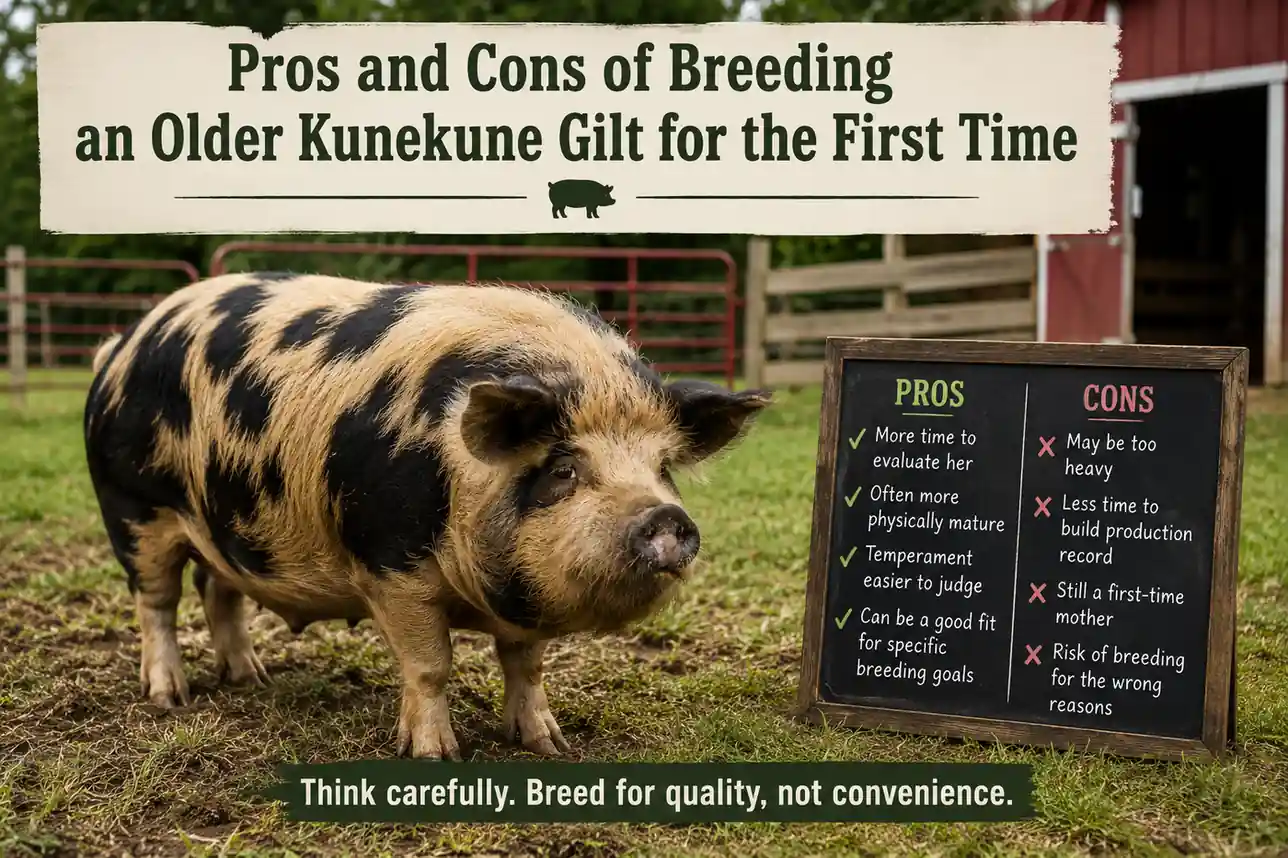
The pros are real: more maturity, more time to evaluate her, and a clearer picture of her usefulness. The cons are real too: possible excess weight, less production history, first-time farrowing uncertainty, repeated heat cycles without conceiving, and the temptation to breed her simply because she is still there.
A good breeding decision should feel thoughtful, not rushed. If the older gilt is truly sound, healthy, useful, cycling normally, settling when properly bred, and a strong fit for the program, she may deserve her chance. If she is not, the responsible choice may be to appreciate her for what she is and leave her out of the breeding pen.
