
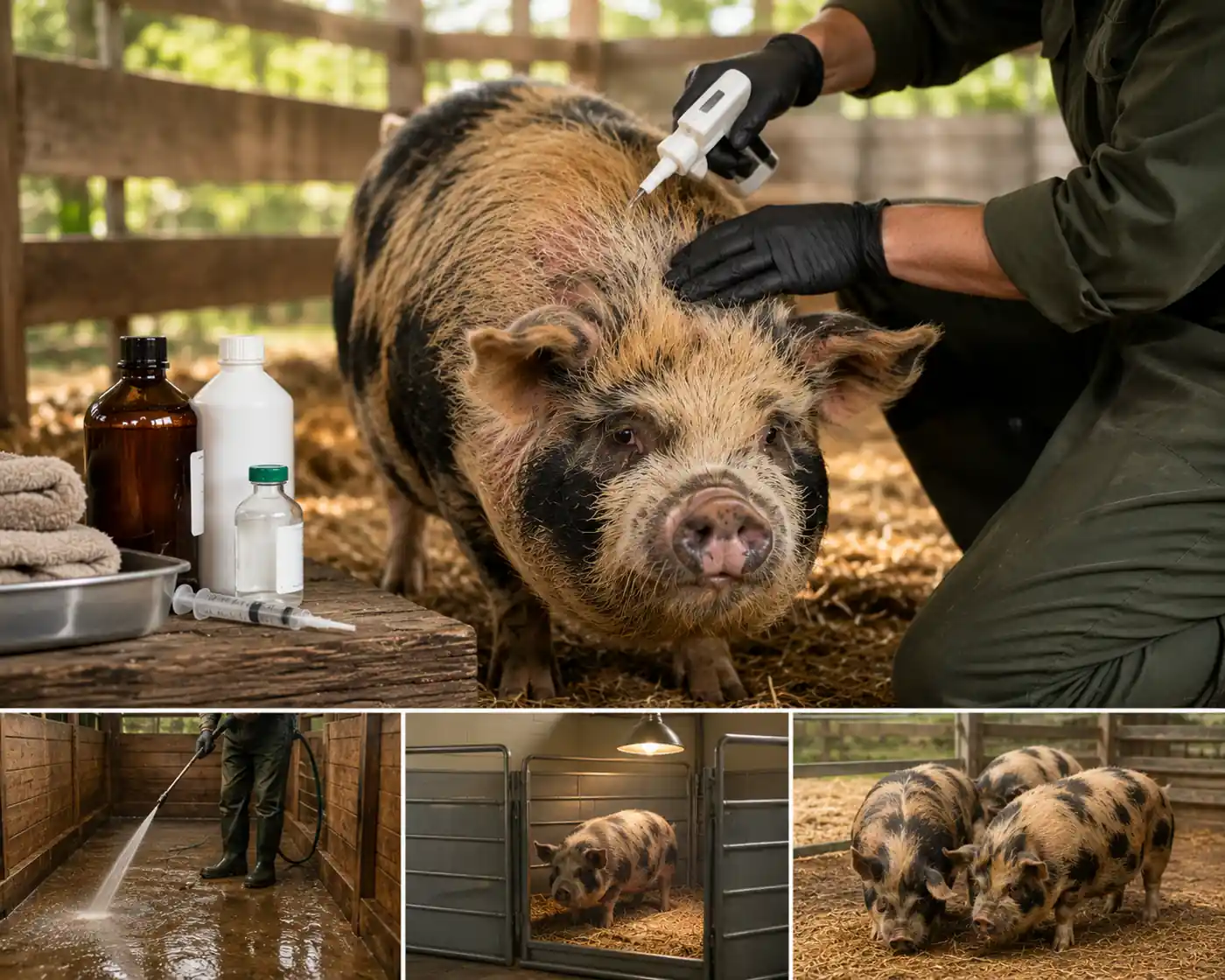
Kunekune pigs are hardy, personable, pasture-friendly pigs, but they are still pigs. They rub. They scratch. They flop in dirt. They sleep in bedding. They root around fence lines, trees, posts, barns, shelters, and wallows. Most of that is perfectly normal pig behavior.
The challenge is knowing when normal scratching becomes a health issue.
External parasites such as mites and lice can sneak up slowly. At first, you may notice one pig rubbing against a post a little more than usual. Then the coat starts looking rough. Then you see flaky skin, hair thinning, irritated patches, scabs, or a pig that cannot seem to settle. By the time the whole group is scratching, the problem may have been building for a while.
Around here, we treat mites and lice as a management problem, not a mystery. The goal is simple: notice changes early, check the pigs carefully, involve a veterinarian when needed, treat correctly, and clean up the environment so the problem does not come right back.
This guide is meant to help Kunekune owners understand what they are seeing and what questions to ask. It is not a substitute for veterinary diagnosis or treatment, especially if piglets, breeding animals, severe itching, open sores, or fast-spreading skin problems are involved.
Quick answer: what are the common signs of mites or lice in Kunekune pigs?
The most common signs are:
- frequent scratching or rubbing
- head shaking or ear irritation
- flaky skin or dandruff-like scurf
- rough, dry, dull-looking coat
- hair thinning, especially around ears, neck, shoulders, back, or sides
- red patches, scabs, crusting, or thickened skin
- restless behavior
- poor comfort or poor growth in young pigs
- multiple pigs showing similar signs
Mange in pigs is most often associated with Sarcoptes scabiei var. suis. The Merck Veterinary Manual notes that mange lesions commonly begin around the head and ears before spreading over the body, and that itching can be intense. Source: Merck Veterinary Manual.
Mites vs. lice: what is the difference?
Mites and lice are both external parasites, but they are not the same thing.
Mites are usually microscopic or very hard to see with the naked eye. You may not see the mite, but you see the pig's reaction: itching, rubbing, crusty ears, thickened skin, flaky patches, or hair loss. Sarcoptic mange is the major mite concern in pigs.
Lice are larger and may be visible if you part the hair and look closely near the skin. Hog lice are blood-feeding lice that live on swine. The hog louse, Haematopinus suis, is large enough to see without magnification and is the swine louse most pig owners are usually talking about when they say "lice." Source: Haematopinus suis overview.
A simple way to think about it:
If you can see moving insects near the skin, think lice. If you mostly see intense itching, crusty ears, thickened skin, and no obvious bug, think mites or mange.
That is not a perfect diagnosis, but it helps you know what to look for.
Why Kunekune pigs may be easy to overlook
Kunekunes often have thick coats, especially in cooler weather. That coat can hide early skin trouble. A pig may look fine from across the pen, but when you part the hair along the neck, behind the ears, shoulders, belly line, or back, the skin may tell a different story.
Kunekunes are also naturally round, calm pigs. A quiet pig with a rough coat may not look "sick" at first. That is why hands-on observation matters. If your pig allows it, scratch along the shoulders, part the coat, look near the ears, and check the areas where the pig has been rubbing.
The earliest clues are often not dramatic. You may notice:
- fence posts or trees being used as scratching spots
- hair stuck to rough boards or wire
- pigs rubbing after lying down
- piglets acting restless
- dry flakes along the back
- ear edges looking crusty or irritated
- a pig that does not enjoy being touched in places that used to be fine
Small changes are worth paying attention to.
How mites and lice spread
External parasites spread mostly through close contact and shared spaces. That matters because Kunekunes are social. They sleep together, graze together, rub on the same posts, use the same shelters, and share bedding.
Merck notes that sarcoptic mange can spread rapidly through direct contact between infested and uninfested pigs, including from sow to piglets. It can also spread through contaminated objects and pens. That is why treatment is not just about one itchy pig. Source: Merck Veterinary Manual.
If one pig has mites or lice, ask:
- Who sleeps with that pig?
- Who shares bedding?
- Who shares the trailer, crate, shelter, or pen?
- Did a new pig recently arrive?
- Did pigs recently return from transport, breeding, showing, or outside contact?
- Are piglets nursing from a sow who may be carrying parasites?
- Was bedding added from a source that could carry pests?
A single untreated pig or contaminated space can keep the problem going. That is the little livestock gremlin nobody wants, but everybody eventually learns to respect.
Where to check on the pig
When checking a Kunekune for mites, lice, or skin irritation, look closely at:
- inside and around the ears
- behind the ears
- neck and shoulder area
- along the back
- belly line
- armpit area
- tail head
- flanks
- places where hair looks thin
- places where the pig rubs most often
For lice, part the hair and look near the skin. Watch for crawling insects or small eggs attached to hair. For mites, you may not see the parasite, but crusting, thickened skin, scabs, and constant itching are clues.
Mange lesions in pigs often begin around the head and ears, then can spread to the rest of the body. Source: Merck Veterinary Manual.
Do not confuse every skin problem with mites
This is where pig owners can get tripped up. Not every itchy or flaky pig has mites.
Other possibilities include:
- dry winter skin
- sunburn
- mud irritation
- bedding irritation
- poor nutrition
- mineral imbalance
- fungal or bacterial skin infection
- wounds from rubbing
- allergic irritation
- old coat shedding
- heat, humidity, or poor ventilation
- external parasites other than mites or lice
The problem is that these can overlap. A pig with mites may scratch enough to create wounds. A pig with dry skin may scratch and look like it has parasites. A pig with lice may develop secondary skin irritation.
That is why a veterinarian can be valuable, especially when the problem is severe, spreading, recurring, or not responding to basic management changes.
When to call a vet
Call a vet if you see:
- open sores
- bleeding from rubbing
- thick crusts around ears or face
- severe itching
- rapid hair loss
- piglets affected
- a nursing sow affected
- weight loss or poor growth
- lethargy
- fever
- swelling
- skin that smells infected
- multiple pigs affected at once
- symptoms returning after treatment
- uncertainty about which product is safe for pigs
You should also call your vet before using medications, sprays, injectables, or pour-ons if you are unsure about species approval, dosage, withdrawal times, age safety, pregnancy safety, or whether the pig is intended for meat.
Treatment: the big-picture approach
This article is not going to give dosing instructions. That needs to come from your veterinarian and the product label. But the big-picture approach is important.
A good treatment plan usually considers:
- The pig
- The whole group
- The environment
- Timing
- Recheck
For mange and lice control, treatment often needs to be handled as a herd or group issue. If pigs are sharing bedding, shelter, pens, rubbing posts, or trailers, treating only the worst-looking pig may not solve the problem.
Macrocyclic lactones such as ivermectin and doramectin are commonly discussed in pig parasite control. The key is using the right product, for the right animal, at the right dose, with the right withdrawal period, and with veterinary guidance.
What we use at BF Farm Kunekune Pigs: Dectomax in our piglet routine
At BF Farm Kunekune Pigs, our preferred parasite-control product is Dectomax. Dectomax contains doramectin. It is not ivermectin, but it is in the same broad macrocyclic lactone family of antiparasitic products.
The official Dectomax label describes it as a 1% injectable solution for cattle and swine containing 10 mg/mL doramectin. For swine, the label lists treatment and control claims for several internal and external parasites, including gastrointestinal roundworms, lungworms, kidney worms, Sarcoptes scabiei var. suis mange mites, and Haematopinus suis sucking lice. Source: DailyMed Dectomax label.
On our farm, we treat piglets at about 2 weeks of age as part of our herd-health routine. We like Dectomax because it fits well into a planned parasite-control program for piglets, sows, and groups that share bedding and shelter space.
The product label also states that studies demonstrated safety in piglets treated at up to three times the recommended dose. That said, we still do not recommend guessing. Piglet weight matters. Age matters. Product handling matters. Meat withdrawal matters. Your veterinarian and the product label should guide how it is used. Source: DailyMed Dectomax label.
For swine, the Dectomax label also states that pigs should not be slaughtered for human consumption within 24 days of treatment. That matters for homesteads and farms raising pigs for meat. Source: DailyMed Dectomax label.
Dectomax is a tool, not a substitute for good management. We still pay attention to bedding, dry shelter, quarantine, clean pens, and routine observation. A product can knock down parasites, but management is what helps prevent the cycle from starting again.
Why one treatment may not be enough
Parasite life cycles matter. Eggs, immature stages, reinfestation from bedding, and untreated animals can all make a problem seem like it "came back."
Sometimes it never really left.
This is why many parasite plans involve a follow-up window, cleaning bedding, watching the whole group, and checking new pigs before they join the herd.
The Dectomax label specifically recommends treating all animals in the herd when initiating control of mange and sucking lice in swine, and it warns that reinfestation can happen from exposure to untreated animals or contaminated facilities. Source: DailyMed Dectomax label.
Environment matters more than people think
External parasite control is not just a bottle or injection. Barn and bedding management matter.
Helpful steps may include:
- removing old bedding
- cleaning shelters
- letting pens dry when possible
- reducing dampness
- avoiding overcrowding
- checking rubbing posts and shelters
- rotating or resting areas when practical
- keeping quarantine areas separate
- not sharing brushes, blankets, crates, or transport gear without cleaning
- watching new pigs before mixing them in
On a small farm, bedding is one of the big ones. Pigs love bedding. Parasites love places where animals rest, rub, and return night after night. If you treat the pig but ignore the bedding, you may be giving the problem a second chance.
Quarantine new Kunekune pigs before mixing
This is one of the easiest places to prevent a headache.
Any new pig coming onto the farm should have a quarantine period before joining the main herd. During that time, watch for scratching, hair loss, coughing, diarrhea, poor appetite, unusual behavior, skin crusting, or parasite signs.
A good quarantine setup should include:
- separate pen or shelter
- no nose-to-nose contact if possible
- separate bedding
- separate feed and water tools
- boots or chores done in an order that prevents cross-contamination
- daily observation
- skin and coat checks
- vet-guided parasite plan if needed
Do not let a new pig step off a trailer and walk straight into your main herd. That is how one small problem becomes everybody's problem.
What BF Farm Kunekune Pigs watches for in piglets
Piglets deserve extra attention because they are small, growing fast, and often close to the sow and littermates.
In piglets, watch for:
- restlessness
- not nursing well
- rough or dull coat
- scratching against sow, walls, or bedding
- scabs around ears or face
- poor growth compared with littermates
- hair thinning
- irritated skin from rubbing
Piglets can decline faster than adult pigs. If young piglets show significant skin irritation, do not wait too long to ask a vet.
Our own piglet routine includes hands-on observation and Dectomax treatment at about 2 weeks of age. We see that as part of a broader herd-health plan, not as the only thing that matters.
Prevention checklist for Kunekune owners
Here is a practical checklist:
- Check ears, neck, shoulders, back, belly line, and tail head regularly.
- Watch for rubbing spots on fences, posts, walls, and trees.
- Keep shelters dry and bedded cleanly.
- Replace old bedding when parasite problems are suspected.
- Quarantine new pigs before mixing.
- Check new pigs for lice, mange signs, wounds, and rough coats.
- Treat the whole affected group when your vet recommends it.
- Follow product labels exactly.
- Respect meat withdrawal times.
- Do not use products meant for other species unless your vet directs it.
- Recheck pigs after treatment.
- Keep notes on date, product, vet instructions, and response.
- Call a vet if symptoms are severe, recurring, or spreading.
Common mistakes owners make
Mistake 1: Treating only the itchiest pig
If three pigs sleep together and only one is scratching badly, the others may still be exposed. Treating only the worst-looking pig may not solve the herd problem.
Mistake 2: Forgetting bedding and pens
The environment can keep pressure on the herd. Old bedding, shared shelters, contaminated crates, and repeated contact with the same rubbing spots can all matter.
Mistake 3: Assuming dry skin is always harmless
Dry skin happens, but heavy scratching, hair loss, scabs, crusty ears, and multiple pigs affected should not be brushed off.
Mistake 4: Using the wrong product
Not every livestock product is labeled for pigs. Not every product is safe for every age, weight, pregnancy status, or meat-use situation. Ask your vet.
Mistake 5: Ignoring follow-up
If you do not recheck, you do not know whether the plan worked.
Frequently asked questions
Can Kunekune pigs get mites?
Yes. Kunekunes are pigs, and pigs can develop mange caused by mites, especially sarcoptic mange caused by Sarcoptes scabiei var. suis. Source: Merck Veterinary Manual.
Can I see mites on my pig?
Usually not easily. Mites are tiny, and owners often notice the pig's reaction first: itching, rubbing, crusty skin, ear irritation, hair loss, or thickened skin.
Can I see lice on my pig?
Sometimes, yes. Hog lice are much larger than mites and may be visible when you part the hair and look near the skin. Source: Haematopinus suis overview.
What does BF Farm Kunekune Pigs use for parasite control?
BF Farm Kunekune Pigs likes Dectomax, which contains doramectin. We treat piglets at about 2 weeks of age as part of our herd-health routine. Dectomax is labeled for cattle and swine, and the official label includes swine claims for mange mites and sucking lice, among other parasites. Source: DailyMed Dectomax label.
Is Dectomax ivermectin?
No. Dectomax is doramectin, not ivermectin. Both are in the broader macrocyclic lactone family, but they are different active ingredients.
Should I treat every pig?
That depends on your vet's recommendation and the situation, but herd-level treatment is often important when parasites are suspected. The Dectomax label recommends treating all animals in the herd when initiating control of mange and sucking lice in swine. Source: DailyMed Dectomax label.
Can mites spread through bedding or pens?
Yes, contaminated spaces can matter. Shared bedding, shelters, crates, trailers, and pens can help keep parasite problems going, especially when pigs are in close contact.
Should I use Dectomax or ivermectin?
Ask your veterinarian. Dectomax is the product we prefer at BF Farm Kunekune Pigs, but the right product depends on your pigs, their age and weight, your herd situation, your goals, and whether any animals may enter the food chain. Follow the label and your vet's instructions.
Final thoughts
Mites and lice are not a sign that someone is a bad pig owner. They are a sign that livestock needs regular observation and good management.
The key is not panic. The key is a plan.
Look closely. Catch signs early. Quarantine new animals. Keep bedding and shelters managed. Treat the whole problem, not just the most obvious pig. Work with a vet when symptoms are severe, spreading, recurring, or not improving.
At BF Farm Kunekune Pigs, parasite control starts early. We treat piglets at about 2 weeks of age with Dectomax as part of our routine, but we also know that no product replaces good daily observation, clean bedding, and sensible herd management.
Kunekunes are tough little pasture pigs, but they still depend on us to notice the details. A rough coat, a crusty ear, or one pig rubbing harder than usual may be the first clue that something needs attention.
And when it comes to parasites, early attention is a whole lot easier than playing catch-up later.