
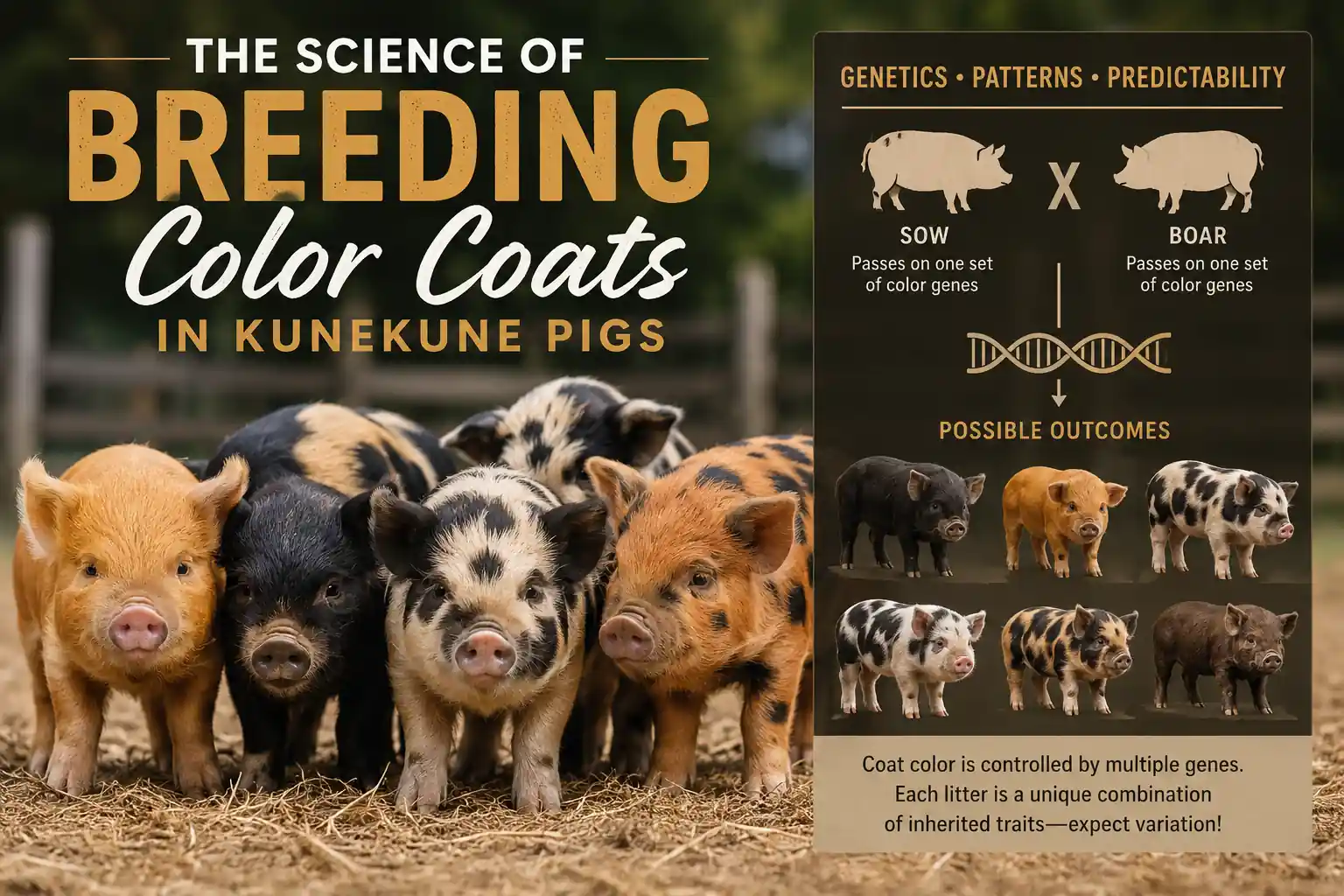
One of the first things people notice about Kunekune pigs is their incredible variety of coat colors and patterns. From solid black pigs to striking ginger-and-white spotted animals, the breed offers a visual diversity that few livestock breeds can match. It is no surprise that prospective owners often ask whether specific colors can be planned, predicted, or selectively bred.
The answer is both yes and no.
Modern genetics allows breeders to improve the odds of producing certain coat colors and patterns, but color inheritance is rarely as simple as matching two pigs and expecting an exact result. Responsible breeders understand that while coat color is interesting and enjoyable, it should never outweigh health, temperament, structure, fertility, and overall breed quality.
Why Kunekune Pigs Display So Many Colors
Unlike breeds that have been heavily selected for a single color standard, Kunekune pigs have retained a wide range of accepted color varieties throughout their history.
Common colors include:
- Black
- Ginger
- Cream
- White
- Brown
- Tri-color combinations
- Black and white spotted
- Ginger and black combinations
- Belted patterns
- Speckled and patched variations
Because multiple color genes exist within the breed population, each pig carries a unique genetic package that can produce surprising results when paired with another pig.
This diversity is one reason many homesteaders and breeders are drawn to Kunekunes. No two litters are exactly alike.
Understanding Basic Pig Color Genetics
Coat color is controlled by genes passed from both the boar and the sow.
Every pig receives:
- One set of color genes from its father
- One set of color genes from its mother
Some genes are dominant, meaning they are more likely to show in the offspring. Others are recessive and may remain hidden for generations before appearing unexpectedly in a litter.
A pig that appears solid black may still carry genes for spotting, ginger coloring, or other patterns that are not visible in its own coat.
This is why experienced breeders often study family pedigrees rather than relying solely on the appearance of the parents.
Why Two Similar Pigs Can Produce Different-Colored Piglets
One lesson that shows up fast in breeding programs is that appearance alone does not tell the whole story.
For example:
- Two black pigs may produce spotted piglets.
- Two spotted pigs may produce solid-colored piglets.
- A ginger-colored pair may occasionally produce darker offspring.
- Hidden recessive genes can reappear after several generations.
The practical reality is that every breeding involves probabilities rather than guarantees.
A breeder may improve the likelihood of producing a certain color, but genetics always has the final say.
The Role of Pedigrees in Color Prediction
Successful breeders learn to look beyond individual pigs and examine entire family lines.
Pedigrees can reveal:
- Common color patterns within a bloodline
- Recurring markings across generations
- Hidden traits that frequently reappear
- Genetic consistency within a breeding program
When a particular color has appeared repeatedly throughout multiple generations, breeders gain a better understanding of what future litters may produce.
That does not create certainty, but it can improve predictability.
Color Selection vs. Responsible Breeding
Color can be exciting, but it should never become the primary breeding goal.
On a working farm, the most valuable breeding pigs are not necessarily the rarest colors. The pigs that contribute most to a herd are those that demonstrate:
- Strong structure
- Good feet and legs
- Calm temperament
- Healthy growth
- Sound reproductive traits
- Longevity
- Good mothering ability
A visually impressive pig with poor structure or temperament can create long-term problems within a breeding program.
Responsible breeders prioritize the traits that affect the future health and usefulness of the herd first. Color becomes a bonus rather than the main objective.
Can Breeders Guarantee Specific Colors?
No ethical breeder can guarantee exact coat colors in a future litter.
Even when both parents consistently produce certain patterns, genetics can always introduce surprises.
A breeder may be able to say:
- Certain colors are likely.
- Certain patterns are common within the bloodline.
- Previous litters have shown similar results.
However, guaranteeing exact outcomes would ignore the complexity of genetic inheritance.
This unpredictability is part of what makes breeding livestock both fascinating and challenging.
How Modern Breeders Use Genetic Knowledge
Today's breeders have more tools than ever before to understand inherited traits.
By combining:
- Pedigree analysis
- Performance records
- Multi-generation observations
- Genetic testing when available
breeders can make more informed decisions about pairings and expected outcomes.
The best breeding programs use this information not simply to create attractive pigs, but to strengthen the overall quality of future generations.
What Buyers Should Focus On
When selecting a Kunekune piglet, coat color is often the first characteristic that catches the eye. Yet the traits that matter most over the next ten to fifteen years are usually less obvious.
Prospective owners should pay close attention to:
- Temperament
- Health history
- Structure and movement
- Parent quality
- Breeder reputation
- Long-term goals for the pig
For families wanting quality breeder stock for future meat production or herd development, genetics extends far beyond color. A well-bred pig contributes far more value to a homestead than an unusual coat pattern alone.
Final Thoughts
The science of coat color breeding in Kunekune pigs sits at the intersection of genetics, probability, and careful observation. While experienced breeders can improve the chances of producing certain colors and patterns, nature still enjoys keeping a few surprises in reserve.
The most successful breeding programs balance color with the qualities that truly matter: health, structure, temperament, fertility, and long-term usefulness. When those priorities stay in order, the beautiful variety of Kunekune coat colors becomes an added reward rather than the primary goal.
For anyone interested in building a breeding herd, understanding the genetics behind color is valuable. Understanding the genetics behind quality is essential.